This week's project was initiated by a home ed group on plants and pollination at Ferry Meadows, the local country park. Luckily, unlike the last one on maps, this one wasn't cancelled.
At the Ferry Meadows group they learned about the parts of a flower, and had to label them on their own diagram. They then re-enacted the pollination process of bees and flowers outside by transferring water between buckets and putting stickers on each other. Finally they went on a nature walk around the park, identifying plants and flowers and using some to make a flower pressing.
Ferry Meadows Workshop with Solomon 'the Flower'
We planted some seeds of our own in the garden (carrots and parsnips), and put beans in jars with cotton wool to see how they grow, making notes in their 'bean diaries'.
Bean Plants and Diary
Finally they made their own symmetry prints of flowers.
This week's project was inspired by a stop-go animation where a Piet Mondrian 'painting' was created with Lego.
Although we try to ensure there's an art or craft project each week, we would like to do a bit more fine art, and Piet Mondrian seemed an ideal place to start.
The children created their own Mondrian style pieces in Lego:
Solomon (Left) and Monica's (Right) Lego Mondrian
And with crayons:
Solomon (Top) and Monica's (Bottom) Mondrian in Crayon
We visited Tate Modern, to see a couple of original Mondrians, and another work inspired by it:
Finally we finished the week with a Mondrian maths puzzle, which the children really enjoyed exploring on graph paper:
Of course no piece of art exists in isolation, and we studied a host of books and videos exploring the history of art, and what art is, and also visited the National Gallery and the National Portrait Gallery. By the end of trooping around three London galleries in one day everyone was exhausted!
Solomon and Monica each chose a postcard of a picture which they then had to write about, describing what was in the picture and why they liked it.
And Solomon also wanted them to create a piece in the style of Kazimer Malevich after seeing a painting in a book:
Solomon (Left) and Monica's (Right) Malevich-style pieces
During Project 77: Shakespeare! we watched the film West Side Story, and the song America inspired Monica to select it as the week's project (along with the fact her father declared he would never want to live in America!).
We covered American history from the 'discovery' of America by Columbus through to life just before the American civil war. We made use of the traditional American History for Kidson Amazon Prime, and supplemented it with additional videos and discussions that were more challenging to the traditional narrative, e.g., History vs. Christopher Columbus.
It was also nice that, in keeping with the previous week's Shakespeare theme where we had studied The Tempest, there was a TED-Ed video Why Should You Read Shakespeare's the Tempest?that explored how it could be interpreted from the perspective of colonisation.
We also explored the American narrative through three stories: reading an abridged version of Mark Twain's The Adventures of Huckleberry Finn, and watching the animated films An American Tail and An American Tail: Fievel Goes West.
Finally they made their own Statue of Liberty crowns and torches from paper plates and toilet rolls.
As it was Shakespeare Week, and there were a host of resources available online, we decided to make it the topic of this week's project, looking at three of his plays (a comedy, a tragedy, and a history play): The Tempest; Romeo and Juliet; and Richard III.
Finally, for Richard III we just watched Shakespeare Animated Tales: Richard III, a video they had previously watched for Project 69: The Tudors.
We also made use of the brilliant Shakespeare Week web site, a great resource with loads of activities. The children did quizzes, made 'fortune tellers', learned about the changing language, and got ideas for craft activities. The only bad thing about the free site is you have to sign up to access the resources (hence we haven't linked to specific pages here!). Despite this terrible web design decision, it's worth signing up.
Elizabethan Portraits
Unsurprisingly, there's a phenomenal amount of Shakespeare resources available online, and we're already looking forward to introducing a few more plays next year!
Every now and then we have a project that goes wrong from start to finish - it last happened with Project 51: Pond Life, so we were due for another project going wrong.
We'd had a project on maps back at the start of our home education journey (Project 2: All about maps), so it seemed an appropriate time to revisit the topic as there was a maps and orienteering home education workshop at Ferry Meadows. Unfortunately the workshop was cancelled, and as much of the week was to be spent on holiday in the North East, there wasn't much opportunity to come up with other activities. Even the geocache walk we planned had to be cancelled as it started to hail heavily when we were due to go out and there was no time left to reschedule!
We also watched some videos about maps and contour lines, and explored some Ordnance Survey maps of the local area. Finally we insisted on playing a map based board game for our screen-free Sunday.
Scotland Yard Junior
All in all maps turned out to be a bit of a damp squib of a project this time, so we will have to attempt it again in the future.
We read three Dickens stories over the week from the (highly recommended) Usborne Complete Dickens: Great Expectations, Oliver Twist, and Nicholas Nickleby.
The Usborne Complete Dickens
Each story is abridged to about 40 pages, starting with a colourful illustrated guide to the main characters of the stories. It's very accessible for those not yet ready for the full unabridged versions, and the work of Dickens is filled with memorable characters.
On World Book Day itself we visited the Dickens Museum in London. This is the house where Dickens wrote his first books, and is set up in period style.
Charles Dickens Museum
Our children enjoy any museum, and they enjoyed exploring the different types of room and objects of the Victorian age. It's not a particularly child-friendly museum however, and it would benefit from the sort of children's activity trail that other museums often have - If there was such a trail/worksheet, we weren't informed about it.
Book Bingo includes questions about whether you've read a book meeting a certain criteria, which initiated a lot of discussion and debate - especially when Monica and Solomon couldn't agree on whether or not King Arthur was set in a castle!
For their book reviews Monica picked Mary Poppins and Solomon picked William Again (the latest book that we are reading in the Just William series).
This week's project was selected to coincide with a home education day at the highly rated Postal Museum in London.
It was a fantastic day out. The children loved the interactive play space, enjoyed the underground mail rail train ride, and the KS1 & 2 workshop on engineers was both engaging and age appropriate.
Postal Museum
Monica and Solomon are both insistent that we visit again, and it was probably their favourite non-video game museum. Solomon was even inspired to create his own postal museum in Minecraft!
Solomon's Postal Museum (showing play area and post box exhibit)
We also got the children to write their own letters to their grandparents, address the envelopes, buy stamps from the shop, and post them.
Posting Letters to Grandparents
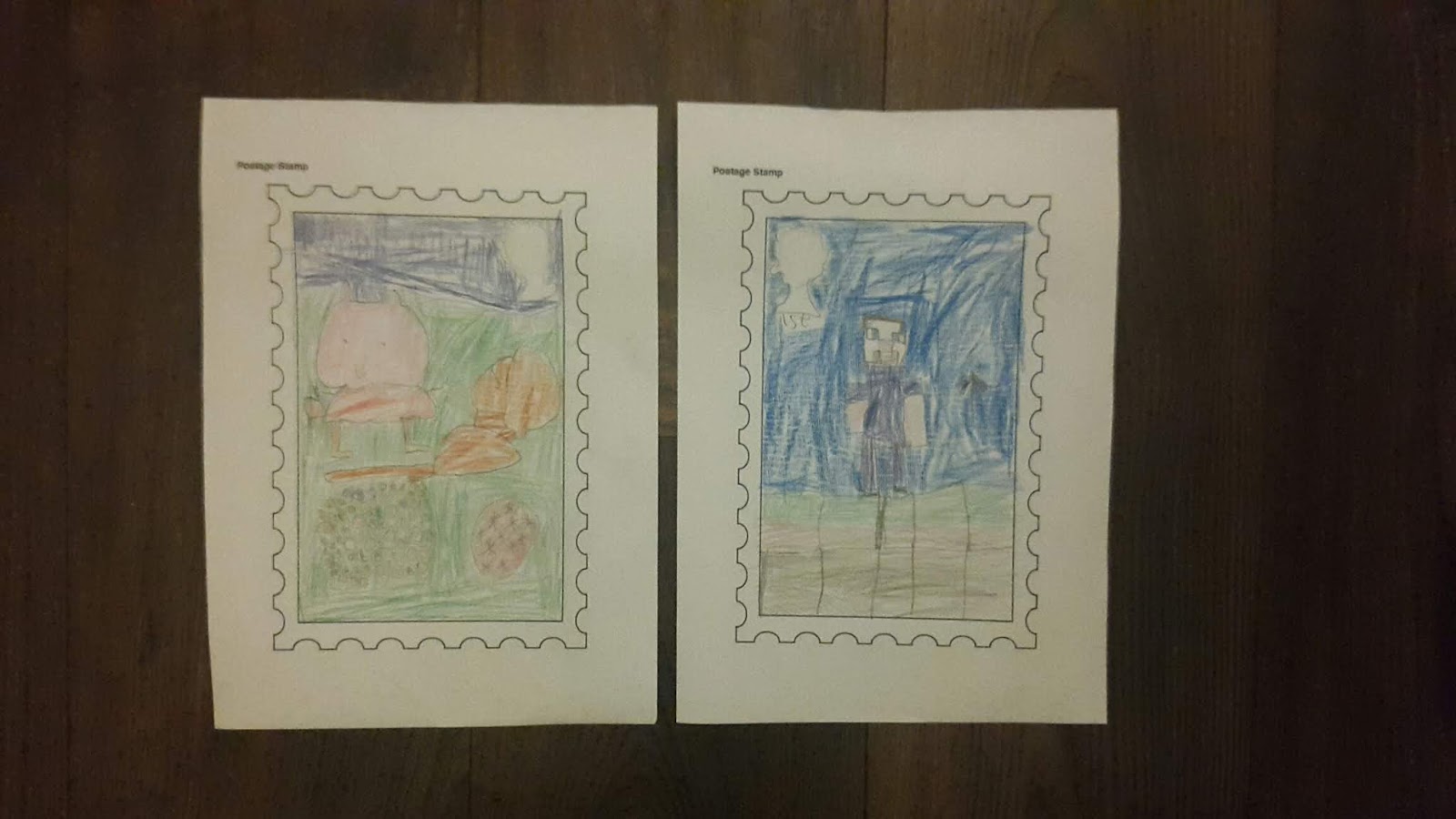
Finally we got the children to design their own stamps.
Peppa Pig and Minecraft Stamps
Next week's project: Charles Dickens (World Book Day).