With bugs still doing the rounds, and a back-log of 'thank you' cards building up, we decided to have one of our literature-focused projects this week*: 'Five Children and It'.
We had enjoyed watching the BBC series as part of Project 113: The Victorians, and so we planned to read the original story and watch the BBC's follow-up series: The Return of the Psammead. While the children loved both of the series, enjoyment of the book unfortunately suffered from being so close to the original TV series. In an age when TV and film executives seem to relish departing from source material, it came as a bit of a shock to find a series following a book so closely!
This week's materials...
The Vintage edition of the story had a number of activity suggestions, and we got the children to write their own list of wishes, draw their own interpretation of the Psammead, and do the included quiz. We also got them to write their own story about finding the Psammead and making a wish: Three Children and It.
Solomon (Left) and Monica's (Right) Psammeads
Nesbit is, undoubtedly, a writer we will return to again in the future: the children want to read The Phoenix and the Carpet and The Story of the Amulet, while it's hard to believe we haven't studied The Railway Children already as we know it so well.
As we are still in the heart of winter, we decided to have a closer look at winter and some snowy habitats, especially as there was a programme on Snow Animals.
It was our third home education Christmas (see also Project 15: All about Christmas!, Project 65: Christmas and the New Year), in addition to a recent project on Christmas crafts (Project 110: Christmas Crafts), so this year we decided to couple our usual round of Christmas carolling, crafts, and cooking, with another classic Christian story The Pilgrim's Progress.
Despite everyone managing to fall for various illnesses over the Christmas period, we nonetheless managed to go to a number of carol services, a Christingle, a live nativity, and of course Santa's grotto.
Carols, Christingle, more carols, and two donkeys.
The Pilgrim's Progress has stood the test of time, and Geraldine McCaughrean's version for children is highly recommended. While we were unimpressed with Blue Peter Book Awards 2019 winner (see Project 112: Refugees), the fact that McCaughrean won the prize for John Bunyan's A Pilgrim's Progress redeems the prize's reputation somewhat. We were less impressed with the quality of the recent animated version, as it is a story that we felt was worthy of something better.
This week's project was prompted by a home education workshop at Ferry Meadows on Natural Art. It's the first time we've had a project based on a Ferry Meadows workshop for while as something invariably goes wrong or the children get very very wet (see Project 89: The Romans).
This time, however, the workshop all went to plan, and the children explored colours in nature, ephemeral art, green man masks, and making a natural object.
Natural Art at Ferry Meadows
We also went out collecting berries, pine cones and greenery to make our own Christmas wreaths, adding some dried oranges for variety.
Christmas Wreaths
Finally we looked more closely at the work of Andy Goldsworthy, following a PowerPoint on Twinkl, and got the children to create their own artworks with coloured matches and shells.
Matches and shell art works
Next weeks' project: Christmas and the Pilgrim's Progress.
This week there was 'A Victorian Christmas Celebration' workshop and trail at Peterborough Museum, so we decided to make the Victorians more generally the topic of the project.
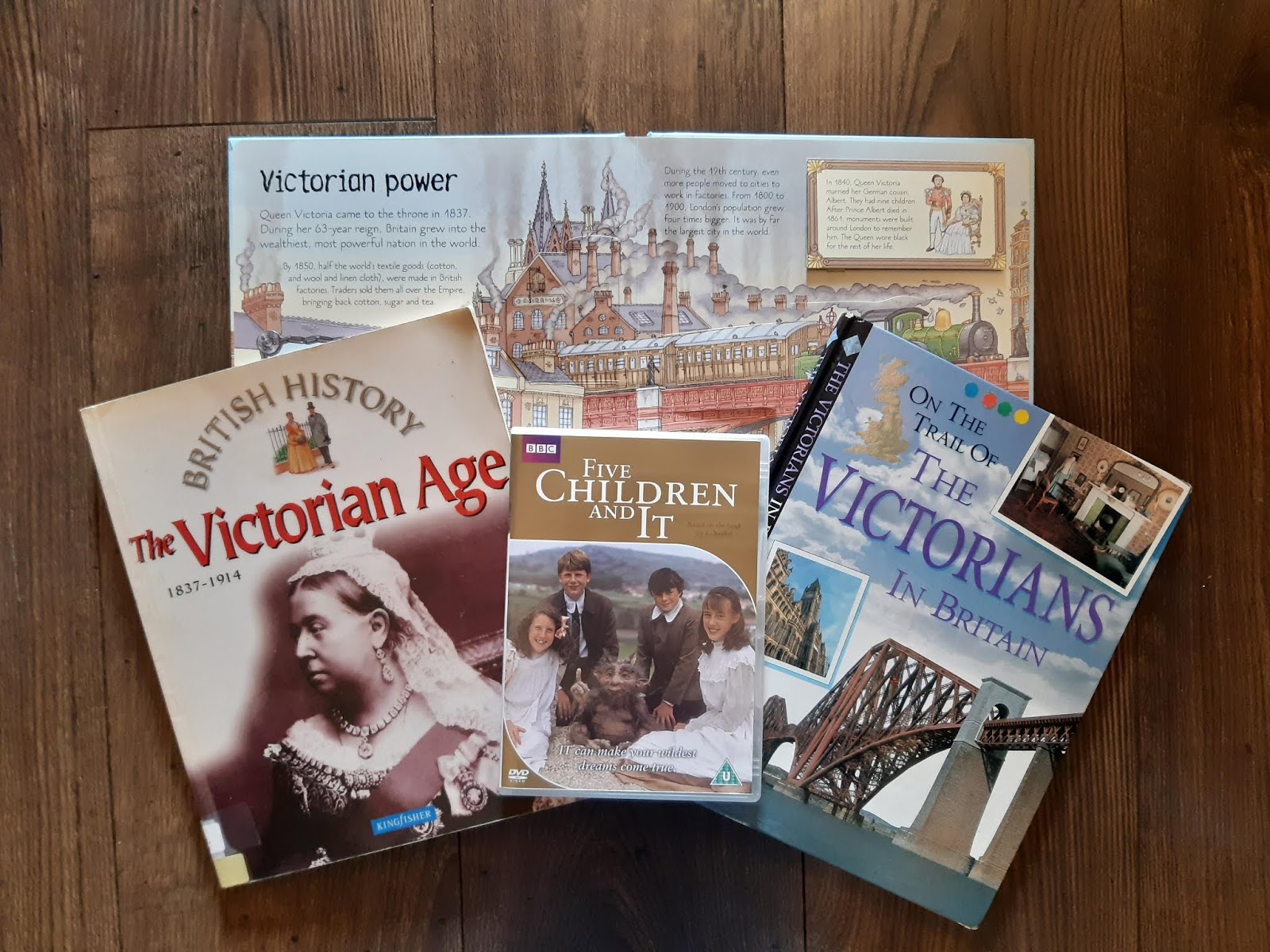
We've previously visited a Victorian prison (Project 3: Medieval Castles), a Victorian row of shops (Project 91: The Seaside), and Charles Dickens' museum (Project 75: Charles Dickens & World Book Day), so besides the trip to the museum our study this week mostly made use books and videos. We watched the Horrible Histories 'Tricky Queen Vicky' and 'Queen Vic's Home Vids' and read a selection of books from the library.
A selection of Victorian resources
The great thing about the project is there are so many books and films written or set in the Victorian period suitable for children., although, with the grandparents visiting for a few days, we barely had a chance to scratch the surface. We have been wanting to watch Zulu since Project 52: Battles!, but unfortunately didn't have the chance. We did, however, start watching the old BBC adaptation of 'Five Children and It', which they are all enjoying.
The trip to the museum included making a Christmas garland and Christmas card, going into a Victorian kitchen to learn about Victorian food, and learning about the Victorian influence on our Christmas traditions.
We picked 'Refugees' as this week's project as there was an exhibition and home education workshop at the local Peterborough Museum.
Refugee exhibit
The workshop introduced the children to the subject of refugees, and there was a mock tent set up to show the children the kind of space refugees have in a typical refugee camp. The children also had to think about the sorts of things they would pack if they had to leave their homes in a hurry, and they also created their own travel logbooks.
Workshop crafts
We also looked at some books about refugees from the library, and did some Twinkl worksheets.
Finally we read The Boy at the Back of the Class, a fictional story about a refugee from Syria who loses his family, and his new friends attempts to help him. It won the Blue Peter Book Award 2019, although we are at a bit of a loss as to why it won. It struck us as badly written with some very odd messages: words are worse than violence, it's acceptable to attack people who are mean to you, and the national shaming of a 9 yr old who has the wrong opinions is to be celebrated. There are books that tackle difficult subjects well (The Boy in the Striped Pyjamas), and books that help you engage with the plight of a refugee (When Hitler Stole Pink Rabbit is a family favourite), but The Boy at the Back of the Class is neither.
Both Solomon and Monica have been speeding ahead with their maths work, but as there isn't a lot of geometry included in the workbooks we use (Schofield and Sims), we decided to make geometry this week's project.
One of the biggest challenges with geometry as a topic is the disparity in maths ability caused by the 18 month age difference between the two children. So we bought a geometry build kit and some activity books they could both make use of.
Some 3D Geometry Shapes
"Dive into Shapes" was £30 on Amazon, and although it says 6+, it's definitely more suited for Monica (5) than Solomon (7). Nonetheless they both enjoyed building the models.
Geometry activity
The geometry activity books, however, were great. They included a wide range of activities, from drawing golden spirals through to parabola with straight lines.
Freehand & Compass Circles
While we only managed to cover half-a-dozen of the activities, we will definitely return to the books again. Surprisingly, geometry turned out to be one of the projects the children have found most interesting!