Monday, 27 May 2019

Project 86: What is Maths?

Solomon and Monica do a lot of maths, diligently working their way through workbook after workbook However there's more to maths than arithmetic, and we felt it was time they had a better understanding of the wide variety of interesting things that maths includes.

We started by showing the wide domain that is maths, including Donald Duck in Mathmagic Land and the drier (but equally interesting) Map of Mathematics.


More practical mathematical activities were based around ideas from MathXplosion, a child-friendly maths series they watched on Amazon Prime, and Maths on Toast, a UK maths education charity.

Along with other more ephemeral activities, they created hexaflexagons:
Hexaflexagons
Explored the power of triangles in building sturdy structures to hold a bag of sugar:
Midget gem and cocktail stick structures (with Dad's winning structure!)
And created their own tessellations:
Tessellations with a cereal box template
Next weeks project: Cooking!

Monday, 20 May 2019

Project 85: Revisiting Programming

In his first year of home education Solomon programmed in both ScratchJr and Scratch:


Unfortunately programming is one of those activities that all too easily gets overlooked on a week-to-week basis. When programming does appear, it is more likely to appear as a programming language associated with a specific technology (e.g., WeDo Lego, or Minecraft) rather than a full programming language. It therefore seemed a good idea to 'Revisit Programming!', and start Monica on her programming journey.

This week Monica worked her way through The Official Scratch Jr Book, while Solomon did a Code Your Own Pirate Adventure and tried a text-based programming language for the first time with Coding for Beginners Using Python.
This week's course books!

Monica really enjoyed programming in Scratch Jr on the tablet, and while Solomon really enjoyed the Scratch pirate games it is possibly a bit too simple for him now.

One of the criticisms of Scratch (and it may be equally applied to Scratch Jr) is that the ease with which you can make bright colourful games makes more formal languages seem dull in comparison. This means there is a real onus on the educator to emphasise the long-term advantages of Python in comparison to a block-based language.

While Solomon was not overly excited by his fist experience of Python, he nevertheless understands it's potential, and has agreed to stick with it. This was probably helped in part by the fact that the 1980's Usborne programming books are available online, and Solomon could recognise the similarity between him learning Python and his father having learned BASIC, but mostly he's just a child who's very good at delayed gratification - four weeks later and he's still eking out his Easter eggs!!

Next week's project: What is Maths?


Monday, 13 May 2019

Project 84: The Emergency Services

We had planned a trip to the National Videogame Museum in Sheffield for this week, and as Sheffield is also home to the National Emergency Services Museum we decided to make that the week's project.

There are plenty of resources for the ambulance and fire services online, with many of the services around the country having outreach programmes. In particularly we made use of the North West Ambulance Service worksheets for how and when to call for an ambulance,  and the Cheshire Fire & Rescue worksheets for making a family emergency escape plan for the house. For the police we focused on their relatively recent history, and both the good and bad points of having a police service:

The National Emergency Services Museum is a nice museum mostly covering the police, fire, and ambulance service, with smaller exhibits on the coastguard and mountain rescue service. The museum has a wide range of exhibits, including a large collection of historical emergency vehicles, a number of reconstructions, and even a climbing wall. There was also an opportunity to go for a ride on a fire engine! The children all enjoyed the museum, and we spent about 2.5 hrs there in total. If I had one criticism of the museum it would be the one-sided view of the police.
Emergency Services Museum
Next project: Revisiting programming.

Monday, 6 May 2019

Project 83: Music!

This week's project was prompted by the fact that we want to get the new Nintendo Labo VR kit, but first we had to finish the variety kit we already had and the last piece to be made was the piano.

Nintendo Labo Piano
The Labo piano is the biggest of the builds in the variety kit, with an estimated build time of 2.5-3.5 hours, so we spread it over a couple of days. The suggested age range is 6+, and while Solomon (6) kept his focus during the build, Monica (4) had a tendency (understandably) to get a bit bored after an hour. As with the previous Labo builds, they're fiddly to make, but the kids love playing with them:


Similarly, there was a guitar build in the LEGO Boost set that we hadn't made yet, so we decided to build that this week too. 
LEGO Boost  Guitar
In this case, the guitar links to a tablet which plays different chords depending on where you place the capo on the fret board and how you 'strum' the lever. The recommended age range for the LEGO Boost is 7-12, but whereas the Labo requires a lot of supervision, they can work through the Boost on their own. 

Of course we also looked at more traditional music and musical instruments. They watched  brief history of  (Western) music, that provided some nice context to modern music. 


They watched the BBC House of Sound videos about different types of instruments, explored Handel's Zadok the Priest, and learned how to read music. 

They also played some musical instruments themselves, playing recorders at home, and then the ukulele at the Peterborough Centre for Young Musicians. They really enjoyed the trial session, and we plan for the ukulele lessons to become a more regular thing. 


Next week: The Emergency Services

Monday, 29 April 2019

Project 82: Football!

Solomon had suggested 'football' as a project as we were scooting past the park one day, and we saved it for this week to include a bit of family rivalry: Peterborough United (the local team) were at home to Sunderland AFC (their mum's team).
Peterborough v. Sunderland

Although we'll have the occasional kick-about, and might watch a match on the TV, it's not particularly a big part of our family culture, so it made a nice change to go to a match: Solomon enjoyed it, and avidly watched the game; Monica watched the crowd, and then read a book for the second half. It was a good game with a noisy atmosphere thanks to the large number of raucous travelling supporters - one ran on the pitch and another set off a flare, which provided a nice introduction to a couple of videos on crowd psychology later in the week.


We also bought FIFA 19 for the Switch, and for a couple of days it even managed to overtake Fortnite as the most popular game in the house, as Solomon explored the various clubs and player skills.

The children used templates from Twinkl to design their own football kits:
Football Kits - as sponsored by Domino's and LNER!
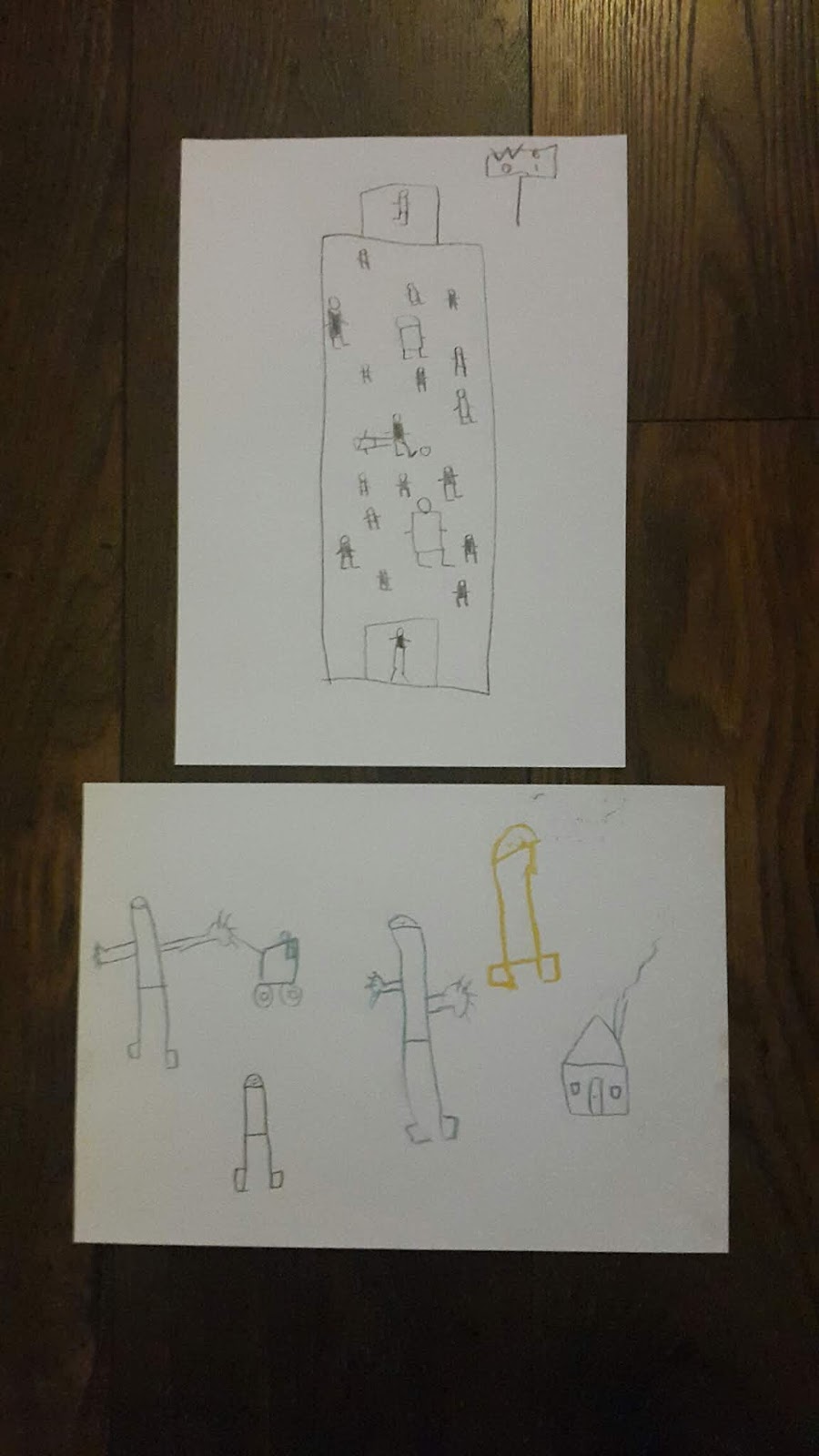
And explored one of the more famous footballing pictures, L.S. Lowry's Going to the Match. Firstly using a Twinkl template to describe what they saw 'Inside the painting', and then drawing some of their own matchstick men:
Matchstick Men

Next week's project: Music

Monday, 22 April 2019

Project 81: Easter II

As it is now our second year of home education, it is also our second Easter as home educators, and unsurprisingly there was some crossover between this year's project and last year's (see Project 29: Easter and Spring). After all, it wouldn't feel like Easter without chocolate nests!

Easter Nests (again).

The children also completed the Easter trail at Peterborough Cathedral:
Easter Trail
Decorated some blown eggs:
Blown Eggs
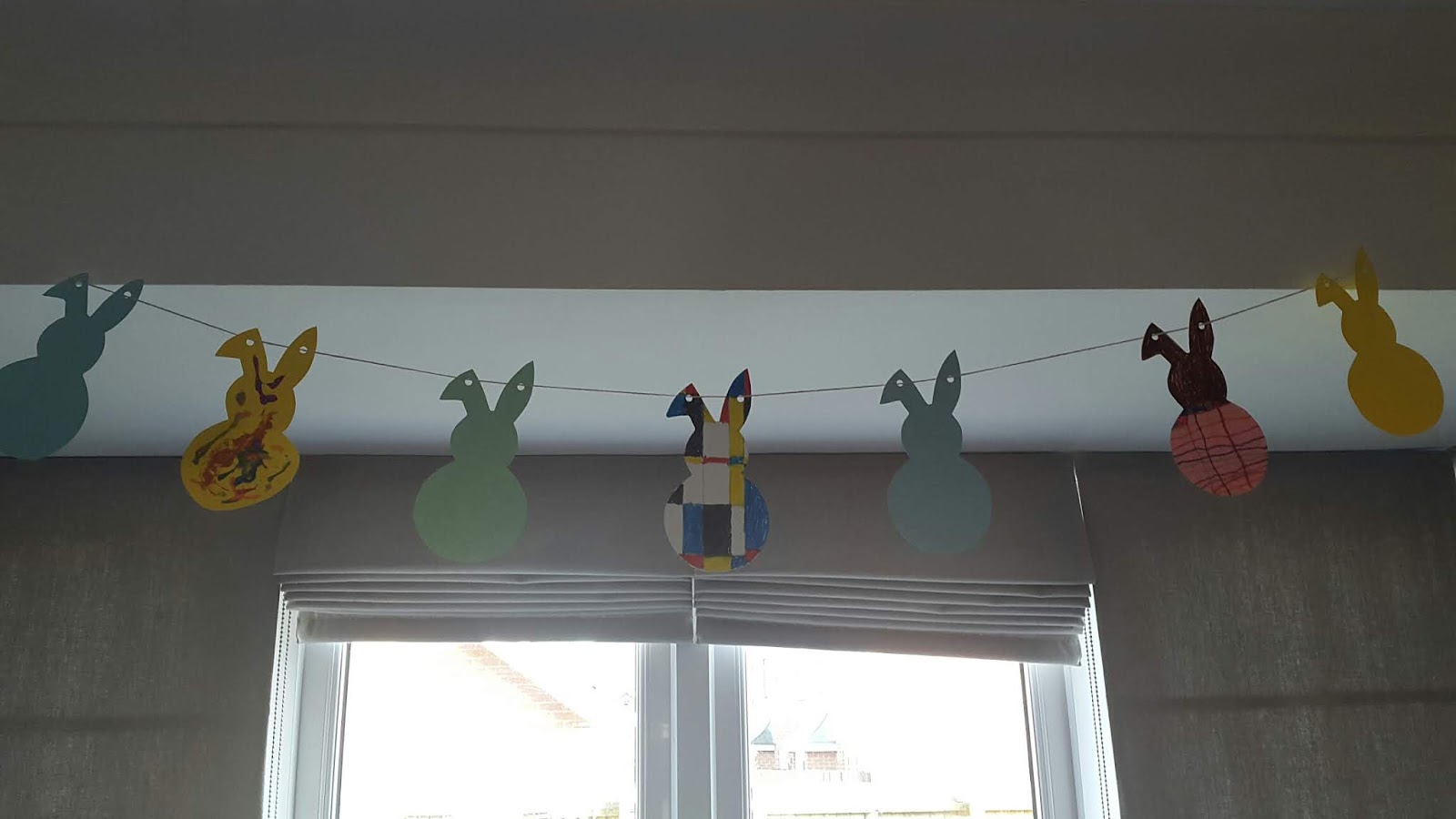
and made some Easter bunting (Solomon decided to make his in the style of Mondrian - Project 79: Art and Mondrian):
Easter bunting
Next week's project: Football.


Sunday, 14 April 2019

Project 80: Plants and Flowers

This week's project was initiated by a home ed group on plants and pollination at Ferry Meadows, the local country park.  Luckily, unlike the last one on maps, this one wasn't cancelled.

At the Ferry Meadows group they learned about the parts of a flower, and had to label them on their own diagram. They then re-enacted the pollination process of bees and flowers outside by transferring water between buckets and putting stickers on each other. Finally they went on a nature walk around the park, identifying plants and flowers and using some to make a flower pressing.
Ferry Meadows Workshop with Solomon 'the Flower'
We planted some seeds of our own in the garden (carrots and parsnips), and put beans in jars with cotton wool to see how they grow, making notes in their 'bean diaries'.
Bean Plants and Diary
Finally they made their own symmetry prints of flowers.
Symmetry flowers
Next week's project: Easter II!  (see also Project 29: Easter and Spring)